
Bahrain VAT Return Filing: Deadlines, Portal Walkthrough and How to Avoid Penalties
The return itself takes fifteen minutes once your books are right. The reason businesses get penalised is almost never the filing — it is that the ledger could not produce the numbers the return demands. Here is the calendar, the boxes and the discipline that connects them.

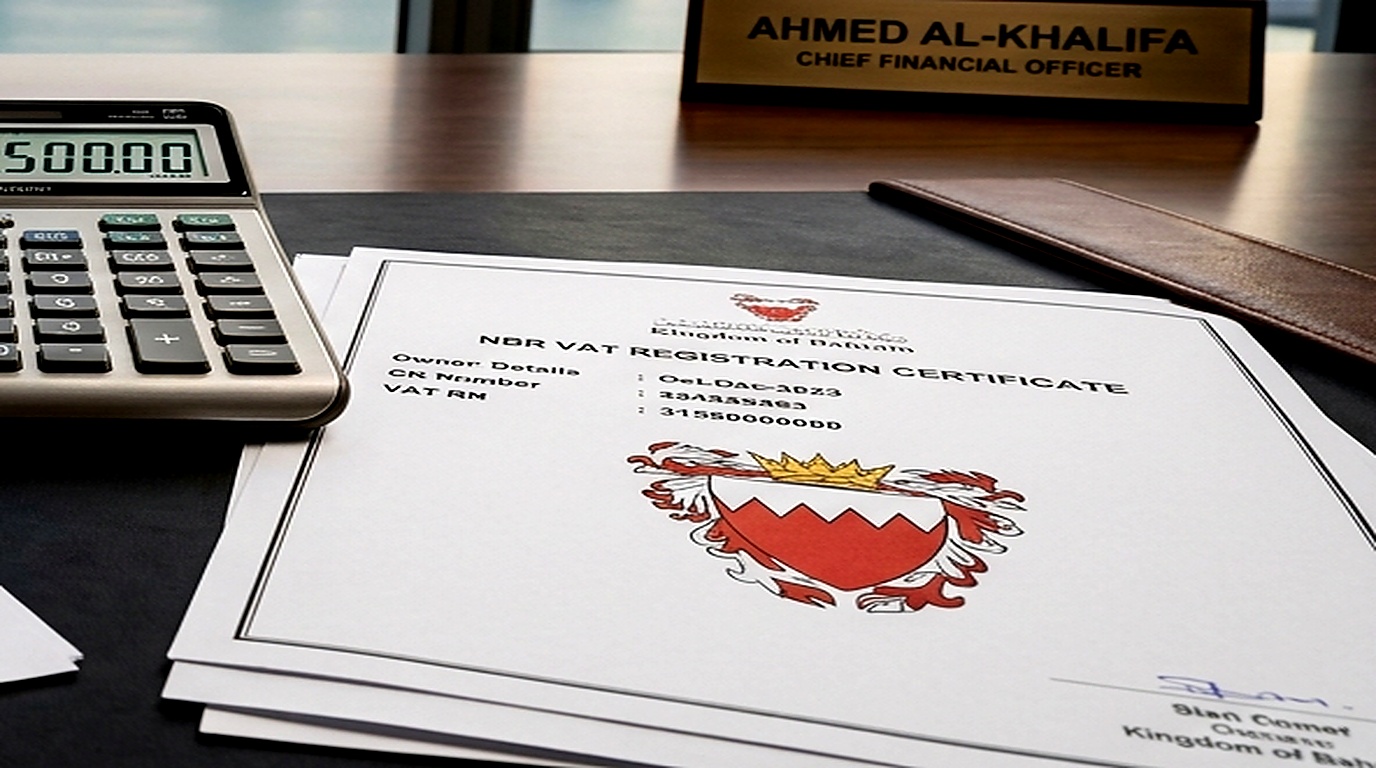
Bahrain VAT returns are filed electronically on the NBR portal, and are due by the last day of the month following the end of the tax period. Businesses with annual taxable supplies above BHD 3,000,000 file monthly; everyone else files quarterly.
Payment is due with the return. A nil return is still required for every period. Filing late where the delay is within 60 days costs between 5% and 25% of the tax — a percentage, not a flat fee, which makes it scale painfully with turnover.
- Quarterly filers
- ≤ BHD 3m turnover
- Monthly filers
- > BHD 3m turnover
- Deadline
- Month-end following
- Late filing
- 5–25% of tax
- Nil return
- Still required
Monthly or quarterly: which are you
Filing frequency is not your choice. It is assigned by the NBR based on annual taxable supplies, using BHD 3,000,000 as the dividing line. Above it, you file monthly. At or below it, you file quarterly.
The Bureau can also change an individual taxpayer's period where it considers it necessary, and is required to give notice before doing so. If you receive such a notice, treat the change as effective from the date stated — the most common failure here is a business that continues filing on the old cycle because nobody actioned the letter.
Your filing frequency is recorded on your tax account, not derived from your own turnover calculation. Confirm it on the portal after registration and again after any material change in scale. Filing on the wrong cycle means periods go unfiled.
The deadline, and why sources disagree
Under the VAT law, the return and any payment are due by the last day of the month following the end of the tax period. On that basis:
| Tax period | Period ends | Return and payment due |
|---|---|---|
| Q1 | 31 March | 30 April |
| Q2 | 30 June | 31 July |
| Q3 | 30 September | 31 October |
| Q4 | 31 December | 31 January |
You will find advisory articles citing the 20th of the following month instead. The discrepancy is real and it is unresolved across secondary sources. Because the penalty for getting this wrong is a percentage of your tax rather than a small fixed fine, the correct approach is not to pick the more comfortable of the two readings.
Confirm the due date shown against each open period on your own NBR tax account, and file to the earlier of the two dates as a matter of policy. Filing ten days early costs nothing. Filing ten days late costs 5–25% of the tax.
If your financial year does not end on 31 December, your tax periods shift accordingly — they follow your declared financial year end, not the calendar.
The return, box by box
The NBR return is not long, but each line has a specific meaning and misclassification between them is a common audit finding. Understanding what belongs where is most of the work.
Output side
You declare the value and the VAT on your supplies, split by treatment. Standard-rated domestic sales at 10% form the bulk for most businesses. Zero-rated supplies — principally exports and international transport — are declared at nil tax but still reported, because they are taxable supplies and they affect your recovery ratio. Sales made under a domestic reverse charge certificate are reported separately from ordinary sales.
Input side
Standard-rated domestic purchases with recoverable VAT. Imports of goods on which VAT was paid at customs or deferred under an NBR grant. Imports of services accounted for under the reverse charge. Purchases subject to the domestic reverse charge. And a line for purchases from non-registered suppliers together with zero-rated and exempt purchases.
Then the adjustments line — this is where apportionment, blocked categories, credit notes and corrections of prior periods land. Finally: total input less adjustments gives allowable input; output less allowable input gives net VAT; prior-period credit is applied; and the remainder is either payable or refundable.
Every one of those lines must be producible from your ledger without manual reclassification at filing time. If preparing a return means re-sorting your purchase ledger into a spreadsheet, your chart of accounts is wrong — and that reclassification will be done under time pressure, every period, by whoever is least able to refuse the work.
Filing on the portal
- Close the period in your books first. Not the day before the deadline — with enough slack to correct what the close reveals.
- Reconcile. Bank, supplier statements, customs entries for imports, and the VAT control account. The VAT control balance should agree to the return before you open the portal.
- Log in and select the open period. The portal shows which periods are awaiting filing — check that it matches your own expectation, in case a period assignment changed.
- Enter the figures line by line. Review the calculated net position against your own computation before submitting.
- Submit and retain the acknowledgement. Save the confirmation and a PDF of the submitted return with the period's working papers.
- Pay. Payment is due with the return, not after it. Confirm the payment has cleared against the tax account — an unpaid return is a late payment even where the return itself was on time.
The nil return trap
This is the most common avoidable penalty we encounter. A business has a quiet quarter, assumes there is nothing to file, and discovers the omission when the penalty notice arrives.
A registered business must file a return for every tax period, whether or not it traded. A dormant company with an active VAT registration and no returns is accumulating exposure every quarter. If the business has genuinely ceased taxable activity, the answer is to apply for deregistration — not to stop filing.
Correcting an error
Errors happen. What matters is how they are handled, because the NBR treats self-identified correction very differently from a discovered one.
Minor errors are generally corrected through the adjustments line in the current period's return, with the working retained to explain the movement.
Material understatements should be raised with the NBR as a voluntary disclosure, accompanied by payment of the difference. Doing this before the Bureau contacts you is materially better positioned than doing it afterwards — and dramatically better than being found out on inspection, where the evasion provisions can come into play.
Submitting false data that increases a declared value attracts a separate penalty of 2.5% to 5% of the unpaid tax for each month or part month. Accuracy is not merely good practice — inaccuracy has its own price.
What lateness actually costs
| Failure | Provision | Penalty |
|---|---|---|
| Late filing, delay within 60 days | Art. 60(A)(1) | 5–25% of tax |
| Late payment, delay within 60 days | Art. 60(A)(1) | 5–25% of tax |
| False data increasing declared value | Art. 60(A)(3) | 2.5–5% per month |
| Failure to notify changes in registered details | Art. 60(B) | Up to BHD 5,000 |
| Failure to provide information requested | Art. 60(B) | Up to BHD 5,000 |
| Tax evasion | Arts. 63–64 | 3–5 yrs + 1–3× tax |
The percentage basis is the point. A 25% penalty on a BHD 400 return is an irritation. The same 25% on a BHD 90,000 quarterly liability is a serious problem — and it arises from exactly the same procedural failure.
Full treatment Bahrain VAT penalties explained: every fine and how to get it waived →The monthly close that makes filing easy
Filing is the last five percent of a process that runs all period. Businesses that file comfortably share the same habits:
- VAT is tagged at the point of entry, on every purchase invoice and sales invoice, never retrospectively.
- The VAT control account is reconciled monthly, not at period end, so discrepancies surface while they are small.
- Imports are tracked to customs documentation, so the import lines can be evidenced immediately.
- Reverse charge is applied systematically to every foreign supplier invoice, not remembered occasionally.
- Credit notes are matched to original invoices and dated into the correct period.
- A pre-filing checklist exists and is signed off by a second person.
Where those six things are true, filing takes an afternoon. Where they are not, it takes a week and produces a return nobody fully trusts.
Key takeaways
- Filing frequency is assigned by the NBR: monthly above BHD 3m annual taxable supplies, quarterly at or below.
- Returns and payment are due by the last day of the month following the tax period — but confirm on your own tax account, since sources also cite the 20th.
- Nil returns are mandatory. A quiet quarter with no filing is a penalty, not a reprieve.
- Late filing within 60 days costs 5–25% of the tax — a percentage, so it scales with your liability.
- Correct errors through the adjustments line, and use voluntary disclosure for material understatements before the NBR raises them.
- The return is only as good as the ledger behind it. Tag VAT at entry, reconcile the control account monthly, and evidence imports and reverse charge as you go.
Behind on a filing, or unsure what a period should show?
We prepare and file Bahrain VAT returns for businesses of every size, and we take over backlogged filings where the historic periods need reconstructing.
General information only, not tax advice on specific facts. Penalty figures reflect Decree-Law No. 48 of 2018 as understood at the date of publication. Filing deadlines shown against open periods on the NBR portal take precedence over any secondary source, including this article.
Frequently Asked Questions
Essential regulatory answers and statutory explanations regarding this topic in Bahrain.
✦ COMPLIANCE
When is the Bahrain VAT return due?
▼
By the last day of the month following the end of the tax period — so a quarter ending 30 September falls due 31 October. Some sources cite the 20th instead; confirm against the open periods on your own NBR tax account and file to the earlier date.
✦ COMPLIANCE
Do I file monthly or quarterly?
▼
Monthly if annual taxable supplies exceed BHD 3,000,000; quarterly at or below that figure. The NBR assigns the period and may change it with notice. It is recorded on your tax account rather than self-determined.
✦ COMPLIANCE
Do I need to file a nil return?
▼
Yes. Every registered business must file for every tax period, traded or not. If the business has genuinely stopped making taxable supplies, apply for deregistration rather than ceasing to file.
✦ COMPLIANCE
What is the late filing penalty?
▼
Between 5% and 25% of the tax to be declared or paid where the delay does not exceed 60 days. The same range applies to late payment. Because it is percentage-based, the exposure grows with the size of your liability.
✦ COMPLIANCE
How do I correct a submitted return?
▼
Minor errors are adjusted in the current period's return with the working retained. Material understatements should be raised as a voluntary disclosure with payment, before the NBR contacts you — that position is treated far more favourably than an error found on inspection.
✦ COMPLIANCE
What if I have a credit balance?
▼
A credit is normally carried forward and set against the next period's liability. Where credits persist, a refund application may be possible — see our guide to VAT refunds for the conditions and the process.